Bolshevik Revolution
Doctor ZhivagoThe Bolshevik Revolution arrives not as a new chapter carefully begun after the old one has ended, but as a force breaking into the middle of daily life. In the novel, that startling immediacy becomes its defining tension: the language of historical renewal accompanies restored military executions, dictatorial commissars, and the reorganization of work and home. The revolution changes institutions and loyalties, but it does not erase the ordinary lives caught inside it; instead, it makes their continuity precarious and their history difficult to separate from disruption.
A New World Begins in the Middle
In a private meditation, a speaker calls the revolution a kind of “splendid surgery,” imagining injustice as an old disease cut out in one decisive stroke. The metaphor makes the event sound at once violent and curative: the old order is sentenced to death, and the ruthlessness of the operation is praised as a capacity to see the task through. The speaker associates this fearlessness with literary qualities—Pushkin’s clarity and Tolstoy’s fidelity to facts—rather than with a political program alone.
The thought turns on a contrast between the customary image of historical construction and what is happening around him. A person asked to create a new world, he suggests, would first clear the ground and wait for the old centuries to finish. The revolution does not wait. It is “exploded right into the very thick of daily life,” beginning in the middle, on an ordinary weekday, while street traffic is still moving. Its apparent genius lies in this indifference to beginnings, schedules, and the orderly separation of one era from another. The novel’s own account of revolution follows that form: political transformation is inseparable from the unfinished routines and needs it interrupts.
Military Discipline and Revolutionary Authority
The war provides one immediate setting for revolutionary rule. As the army disintegrates and anarchy continues, Yurii Andreievich reports touring nearby units and working with a Moscow-born nurse, Antipova. The military crisis is not simply background: a planned offensive brings a campaign to improve morale, the institution of revolutionary courts-martial, and the restoration of the death penalty, recently abolished. Measures presented as necessary to restore order thus reverse a recent political decision and make the threat of execution part of the new authority’s ordinary administration.
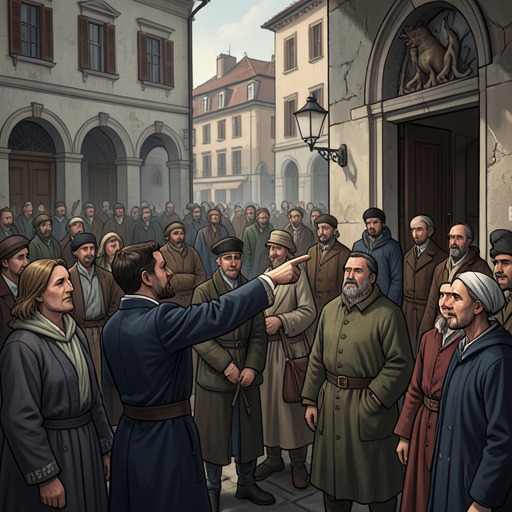
The revolution’s language of collective purpose also meets resistance in the army. When Commissar Gints addresses surrounded soldiers of the 212th Infantry, he invokes duty and the fatherland, but the men are exhausted by war and weary of political phrases. His appeal gives way to a threat: they must disarm and surrender their leaders or face death. The scene exposes a gap between official ideals and the listeners’ experience. The speech cannot make exhausted soldiers feel the meaning its speaker assigns to it; the authority of the revolutionary court is instead made tangible as a penalty.
Institutions Remade, Lives Displaced
The transition unfolds through systems of administration as well as military command. New elections take place across building administrations, organizations, offices, and public services, while commissars with dictatorial powers are appointed to them. These officials reorganize institutions according to a plan, and enterprise after enterprise becomes Bolshevized. The change is concrete and cumulative: it reaches the workplace, the public service, and the bodies charged with managing everyday necessities.
The hospital where Yurii Andreievich remains at work registers the change in miniature. The Hospital of the Holy Cross is renamed the Second Reformed; some employees are dismissed, while others resign. Doctors who had fashionable practices and high fees leave for self-interested reasons but present their departure as civic protest, looking down on those who stay. Yurii stays, even though political camps regard him as suspect in opposite directions: moderates find him dangerous, while those further to the left consider him insufficiently Red. His position is not a confident middle ground but a sign that the new divisions do not neatly contain individual judgment.
Housing is subjected to the same administrative logic. At a meeting, a committee proposes converting a large building into a hostel for visiting delegates and naming it the Tiverzin Hostel in honor of a former resident who had been deported. The residents are told that working people will be rehoused and that others must find accommodation for themselves within a year. Their immediate protest—that they are all working people—collides with the committee’s attempt to classify and remove them. The dispute shows how revolutionary claims about social categories become decisions about who may remain in a home.
Winter, Rupture, and the Passage of Time
Winter gives the political transition its physical and temporal shape. The first of three winters is already dark, hungry, and cold, though less terrifying than the two that follow. Each belongs to the breaking up of familiar life, the reconstruction of its foundations, and the effort to hold on as life seems to slip away. The narration then unsettles the chronology: events remembered as belonging to 1917 and 1918 may have happened later, because the three winters have merged in memory. The revolution is therefore not a single instant that can be neatly dated; its seasons blur into one prolonged experience of upheaval.
The old life and the new order initially stand apart, neither connected nor yet openly hostile as they will be when civil war breaks out a year later. That interval is not reconciliation. It is a tense coexistence between incompatible worlds, each facing the other without a settled relation. Political change is already reorganizing institutions, but the full violence of the later conflict has not yet arrived.
The sense of rupture also follows the Zhivago family beyond Moscow. When their train remains on a siding behind other trains, the family feels that its connection with Moscow has snapped. They have entered a provincial world with its own center of gravity, where people are closer together and differ from the capitals in speech, dress, food, and manners. The revolution’s geography is thus experienced as a break in attachment and a passage into a different social world, not merely as a change of government.
Private Records and Historical Growth
The novel sets large political changes beside documents and acts of writing that preserve individual experience. Yurii Andreievich’s letter to his wife records the army’s disintegration and his work among its units, then discloses, almost as an afterthought, that he works closely with Antipova. Later, at the staff-room window, amid forms recording deaths, illness, wages, political consciousness, elections, and shortages, he writes fragments of a work whose title describes people who have stopped being themselves and are acting unknown parts. The impersonal paperwork and the private writing occupy the same table: one measures a society, the other registers the estrangement of its people.
A delayed letter from Tonia brings another scale of consequence into view. Written on many sheets and arriving in a crumpled, opened envelope after five months, it tells Yurii Andreievich that they have a daughter, Masha, named for his mother, Maria Nikolaievna. It also reports that Tonia, her father, and other prominent people, including Yurii’s uncle Nikolai, are being deported abroad. As he reads, he gradually loses awareness of the room around him. The passage makes political displacement intimate: news of a birth and news of exile reach him together, carried by a damaged letter that has itself been delayed and passed through many hands.
Near the end of his reflections on nature and society, Yurii Andreievich compares history to a forest’s growth. A leafless wood may seem thin and still under winter snow; within days of spring it can rise into a leafy maze, though no observer catches the growth in the act. Society, too, changes continuously while appearing motionless. This image does not cancel the revolution’s violence or its administrative force. It places abrupt political rupture within a longer, less visible transformation, one that cannot be controlled merely by announcing a new beginning. The revolution’s decisive significance lies in that unresolved contrast: it claims to remake the world at once, while the lives and history it enters continue to change in ways no plan can fully command.